
We were planning to go to Wygant, Vinzenz Lausmann, and Seneca Fouts State Parks. I had never heard of any of these places, despite 18 years living within an hour of them, but for Christmas I had gotten Tom (and myself) a 12-month Oregon Parks pass and a pristine copy of Oregon State Parks: A Complete Recreation Guide, by Jan Bannan. So, when we had the opportunity for a late February hike, which usually means heading far enough east into the Columbia River Gorge to escape the Portland shroud, I started thumbing through this book, published in 1993 by The Mountaineers. I had never heard of those folks either, but have since learned they are a nonprofit outdoor activity and conservation club founded in 1906, still going strong today, mostly in the Seattle area.
Jan profiles about 110 of Oregon’s 196 State Parks, Waysides, Recreation Areas, Viewpoints, and Natural Sites. Also, Scenic Corridors. Do I want to visit all of them? Yes. Yes I do. For instance, there is an Erratic Rock State Natural Site that is 4.4 acres and contains a 90-ton rock from the Northern Rocky Mountains that floated down the Columbia as part of an iceberg some 12,000+ years ago, and landed a little ways outside of present day McMinnville. As someone who also found my way to Oregon from the Northern Rockies, albeit by driving beside the Columbia rather than via iceberg, now that I am aware of the “largest glacial erratic found in the Willamette Valley”, I am absolutely going to go stand on that rock. Who’s with me?
For this trip though, we were traveling eastward, back up the Columbia, in search of the sun. To get there, we passed through a downpour torrential enough that I briefly worried we were heading away from that goal instead of towards it. The clouds and mist were circling around cliff tops made even more dramatic than usual by recent snowfall. The waterfalls were hung with icicles, the mossy weeping walls almost completely crystallized into stillness. Then, the light broke through to form a full, fat rainbow spread low over the river. We could have stopped right there and called our journey complete. I might have, if I’d been driving, it it weren’t for the fact that the speeding traffic on an interstate freeway through a narrow gorge makes that difficult.
The last time we had driven this route was at the end of August, on our way to Joseph, Oregon and the Eagle Cap Wilderness for my annual birthday backpacking trip. On the way back on Monday, September 4th, my actual 37th birthday, we made it past The Dalles before turning on our cell phones, losing the Hank FM classic country station, and switching over to the news. The news was: forest fire, straight ahead. I’m glad we didn’t have more advance warning in order to spend more time worrying about it, since there wasn’t anything we would have done differently anyway.
We were detoured over the bridge at Hood River, and made our way, very slowly, through the Washington side of the Gorge, with a view almost too close for comfort of the Mordor-like scene across the river. At the time, of course, we couldn’t help but mourn the greenery and beauty being burned, in the midst of primal awe and fear, in that intimacy with the powerful element of fire through the darkness. We were on the right, safe side of a mighty river, yet still those sparks were traveling toward us, and some, we later learned, did briefly catch on the Washington bank. In the days afterward, people were sharing their favorite photos and stories from Gorge hikes over the years, and not long after that, others were reminding us of the resilience of the forest. Six months later, I thought of loss, strength, and hope as the blackened trees came into view, so many still cleary alive despite the damage.
Passing Ainsworth State Park, with a closed sign, I thought of my own very first Gorge story, which took place there when I was a nineteen-year-old Portland State Student, a small town Montanan excited and a bit overwhelmed to be living in the “big city.” I had taken out a subscription to the Oregonian, and cut out an article from the Outdoors section about Ainsworth. When my parents came to visit in the summer, I proudly navigated us there for a waterfall hike, feeling a sense of joy and belonging in my new home, and eager to share this lush wonderland with the nature lovers who raised me. Three years later and one year after my mom died, I hiked Eagle Creek for the first time, alongside my dad, who told me stories I had never heard about when my parents first met.
Today, the Eagle Creek exit was closed and barricaded too. But we were headed further east, almost all the way to Hood River, to Exit 58, which at least as of 1993, according to our book, “has a sign for Mitchell Point Overlook, but there is no mention of the three parks.” Unlike at Ainsworth and Eagle Creek, where the exit signs themselves had big orange “closed” banners across them, 58 had nothing right at the turnoff to indicate anything was amiss. Just a ways after taking the exit though, we encountered a barrier where the road would have led to the parks. Lest you think I was relying solely on information from 1993, I did look up Wygant, Vinzenz Lausmann, and Seneca Fouts on the Oregon State Parks website, and besides learning that Seneca “would be a great place for a convention if you were a bighorn sheep” and that there was storm damage in 2012, confirmed that day use was open year-round and that “Wygant trail is open.” Alas, I’ll have to reschedule my bighorn sheep convention for a later date. I also visited this site about the fire closures and recovery, which gave me the impression we’d be okay east of Cascade Locks. Perhaps we’re not funding our Parks Department enough to provide detailed updates on all 196 locations throughout the state? At any rate, I’ve decided the fact that our destination didn’t rate a mention on any of the closure lists I found is a good sign that that when we do try again, we may have it to ourselves and the sheep!
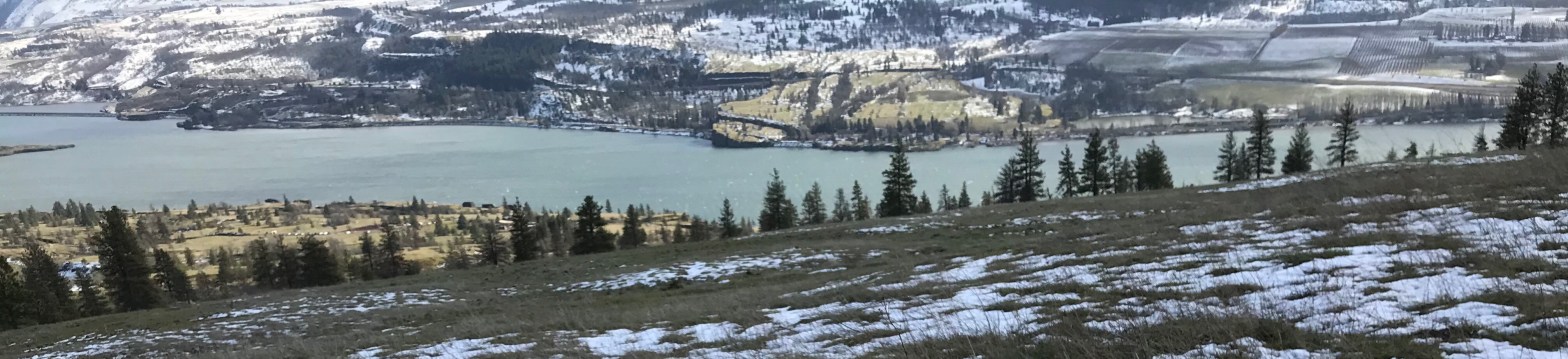
In the end, we crossed the river to Catherine Creek, an old standby that had been Tom’s original idea for this hike anyway. I don’t think I’d ever visited so early in the year, and I thought it might be too soon for many flowers especially with the recent snow, but we were greeted by fields of grass widows and biscuitroot. I love this area for its rambling, somewhat informal trails that remind me of wandering free across Montana landscapes. It has the same sort of crooked Ponderosas as the land where I grew up, perhaps even a bit tougher, shaped by the Gorge winds, and with oak groves instead of aspen.
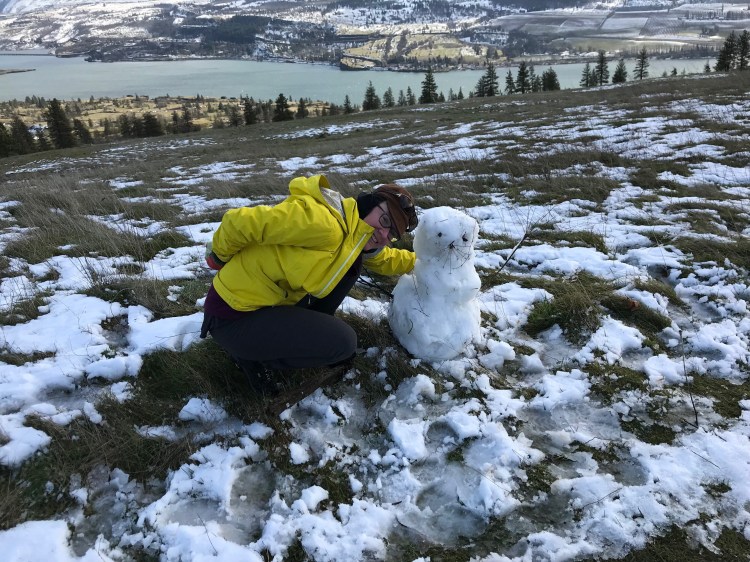
We stopped for a snack and rest on a mossy rock beneath one of those Pondys, where I picked up a piece of puzzle bark shaped like a bird, watched real birds sailing overhead, and let the puzzles of my life just be as they were for a little while. The sun we’d come in search of shone strongly enough to warm my face on the 24th of February, and probably the little snow alien we had spontaneously formed on the ridge above was already well on its way to melting back into ground, feeding the next phase of early spring flowers, running in rivulets down to feed Catherine Creek, the Columbia, the Pacific. I thought about creation and dissolution, and my part in all that, on the scale of a day, a human lifetime, or our dear blue-green planet’s perspective. For a moment, I melted some too, resting in a place, an awareness, that felt like home.
 Vibrant Mission